Growing with Purpose: Building trusts that work
WELCOME
Over the past three years (whilst we’ve been building Robin), I’ve spent a lot of time talking with trust leaders about how trusts grow and mature – from digital strategy and governance, to succession planning and operating models. Those conversations have highlighted how complex it is to lead trusts effectively as they evolve. For this session, we wanted to explore how growth can be a positive experience when people, systems and culture are changing.
We brought together a mix of perspectives from three leaders with deep experience of governance, growth and digital strategy to share what purposeful growth looks like in practice. Some clear themes ran throughout the discussion: the most effective trusts are purpose-driven, collaborative and adaptable – building cultures of collective intelligence and innovation, while staying grounded in the challenges and joy of schools and education. We hope the insights shared here spark reflection, reassurance and practical ideas as you navigate your own trust’s journey.
JOE BLAIR,
Co-founder of Robin Education
---
OUR PANELLISTS
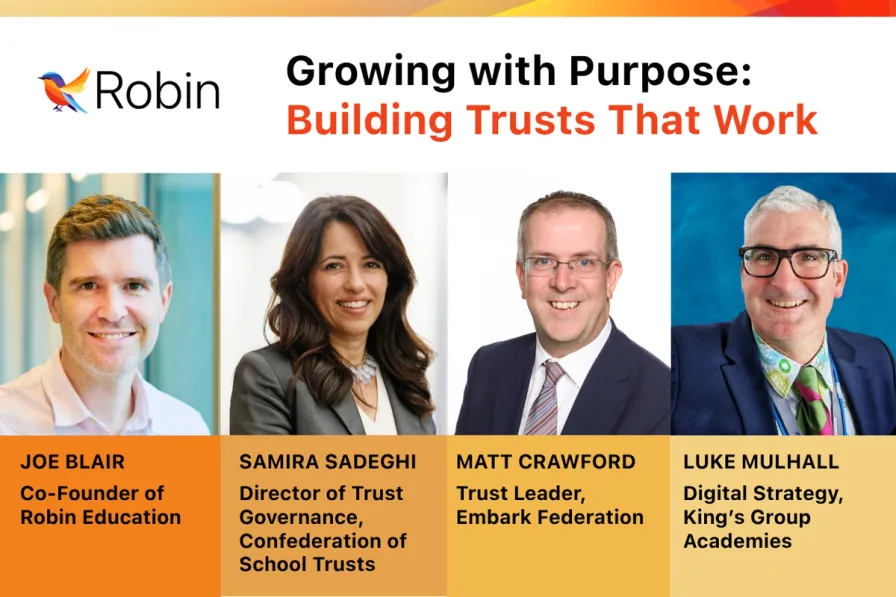
SAMIRA SADEGHI, Director of Trust Governance, Confederation of School Trusts (CST)
Samira has over a decade of experience in school governance. But she started her career working as a lawyer representing California’s Death Row prisoners. She now leads CST’s work on trust governance, including developing trust governance policy and guidance, and facilitating CST’s trustee and governance professional community. Previously she was Head of Governance and Company Secretary at Academies Enterprise Trust (now Lift Schools, with 57 schools) and she began her career in governance as Regional Governance Officer at Ark Schools (39 schools).
MATT CRAWFORD, Trust Leader (CEO), Embark Federation (23 schools in Derby)
Matt has been CEO of Embark Federation since it was a two-school federation in 2017. He’s overseen its growth into a 23 school trust, with many more schools interested in joining. Guided by clear values and disciplined growth principles, Embark does not actively promote itself, instead focusing on doing right by the schools and communities it serves. With more than 83 schools expressing interest over the past 18 months, this values-led approach is clearly resonating.
LUKE MULHALL, Digital Strategy, King’s Group Academies (15 schools across Berkshire, Hampshire and Sussex)
Luke led digital innovation for six years in a trust of five schools before it merged into King’s Group Academies in May 2024. He now leads digital strategy across King’s Group, focusing on high-quality teaching, inclusion through adaptive technology, data and the safe, ethical use of AI. Alongside this he continues to teach Computer Science and STEM subjects.
---
THE PANEL DISCUSSION
Question 1: What works and what doesn’t work in how a central team operates?
Samira (CST):I’d start by not calling it “central team”, I’d call it shared services or anything else. “Central” just conveys a certain image.
Sometimes we get away from the purpose of trusts. We’re here to act as a protective structure for schools, strategic enablers and anchor institutions in communities.
That means reducing friction for schools, taking on those admin and operational burdens and freeing-up school leader time. We also want to amplify expertise (rapid access to high-quality functions) and use resources responsibly so knowledge, funding and capacity go where they have the biggest impact. Ultimately it’s creating conditions for schools to thrive: balancing consistency and contextualisation.
Consistency is foundational, but too much creates cookie-cutter schools and undercuts innovation, local knowledge, local expertise and responsiveness you need within the community. Contextualisation unlocks energy and innovation, but without consistency that can lead to a lack of quality, fragmentation of the trust and duplication.
In the governance context, we always tried to take care of compliance tasks – repeatable, administrative work – anything we can take off schools’ hands. Tools like Robin can reduce time wasted on website compliance and free leaders to focus locally on what matters.
What I’ve seen at scale is leaders often struggle to let go. If trusts stay hierarchical – with many layers of approval – you increase friction. For example, recruitment support that’s so process heavy you lose candidates: you’re then not serving your schools. To scale, trusts need distributed leadership and flatter structures.
Dixons Academies Trust is a good example: their “circles model” empowers small cross-trust teams (curriculum, attendance etc.) to make decisions without constantly going up the chain for approval. It cuts gatekeeping and bureaucracy (the fluff-load), but this does require high levels of trust, strong relationships and cultural alignment. If trusts are going to scale they have to be comfortable with this.
Also operating models aren’t, “one and done.” Actually, it’s an organic thing, it changes, it morphs. Organisations change and structures need revisiting. Dixons rethinks their circles all the time – it’s agile, it moves. But most importantly – it’s the right people making the right decisions with the right information at the right time. That for me is the strength of a trust.
---
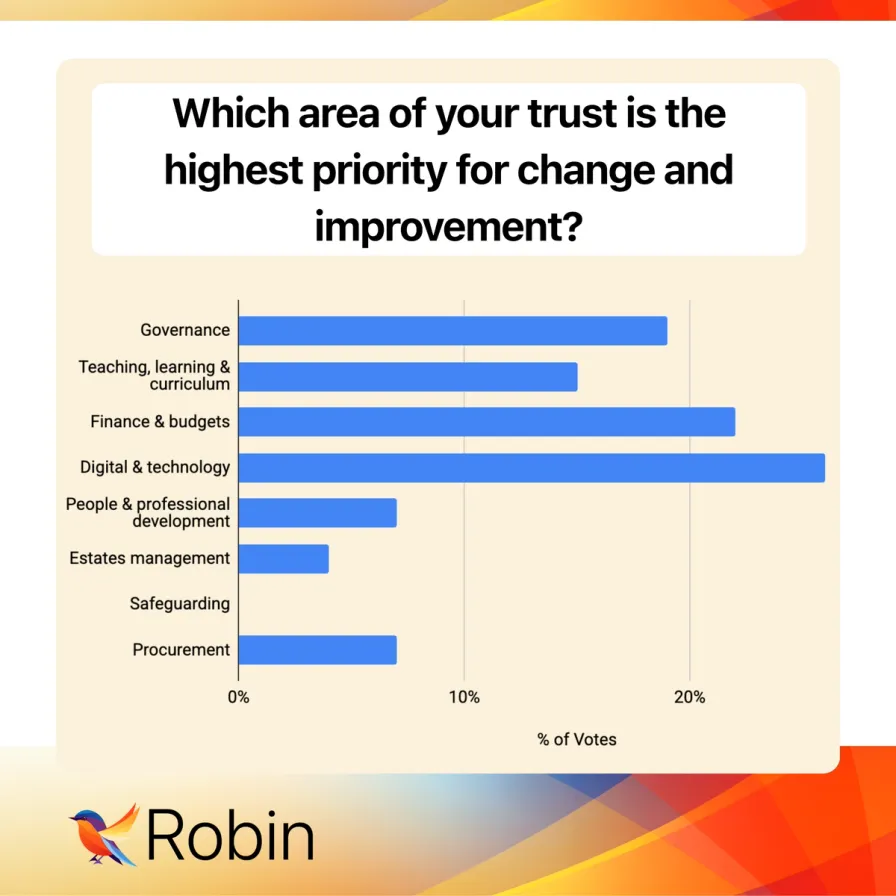
Poll 1: Which area of your trust is the highest priority for change and improvement?
---
Question 2: How do you decide whether to bring more schools into a trust and how does the trust change?
Matt (Embark):Early on at Embark our trust board set out growth principles: simple, but helpful – nothing fancy.
Having started in 2019 we were able to learn from others – one lesson we learnt was that the trusts that failed in the past didn’t have their capacity right. So, we set a “three to one” principle: at least three good or better schools, to those requiring improvement. (This wasn’t just based on Ofsted judgement, but our own judgments, because some Ofsted grades were out of date). Over time we’ve increased that ratio significantly, we’re now over ten to one, which supports our capacity.
Another thing that was set out by trustees was geographical considerations: we focus on Derbyshire, so we can quickly say no to schools outside the county.
We also use a values-based judgment: our values are family, integrity, teamwork and success. We’re not about big egos at Embark, we want the right people around the table. If one of our values is teamwork, and we want people to share and be willing to work together as a team – a couple of bad apples could ruin the essence of our trust. We’ve turned schools away if we felt the cultural fit wasn’t right.
Another interesting principle, especially for us as a growing trust, is that we never approach a school. We decided to focus on doing right by the schools in our trust. And, if we do well by the schools and communities, we hoped it’d peak people’s interest, which has worked and it still takes us by surprise.
We’ve had 83 schools approach us in an 18-month period – from Kent, Leicester, Stoke and Cheshire. But we stick by our simple growth principles and they’ve really helped guide us through the last seven years.
---
Question 3: Digital strategy can feel quite abstract. What specific things have you done (or not done) that have had a positive impact?
Luke (King’s Group):Digital strategy covers a huge area. It’s easy to assume other trusts are doing it better, but our mantra is keeping things simple – ultimately IT should just work.
We focus on consistency and standard platforms (we’re a Google trust). Streamlining platforms makes a huge difference. A lot of focus is unseen infrastructure work – often the bit that costs money, and can look like you’re slowing progress – but it enables everything else.
Our strategy has been consistent for years: children should walk into classrooms and use a device and be online without thinking about it. Typically that does happen, but that comes from ongoing planning around infrastructure (internet, wireless etc.) being in place. At the heart of what we do is teaching and learning, and we’re driven by what happens in the classroom.
We’re not chasing the latest gadgets. We do use AI tools, but we choose the right platforms, (such as Google, Canva and Robin) and we roll them out trust-wide with buy-in: we show people what the tools enable and get people wanting them.
Structurally, we operate flat. I work with a data team made up of data managers in schools – I’m more a conduit: bringing people together to share practice. You find expertise in schools and elevate it, rather than it being remote “central” work.
It was challenging after we merged, particularly with tenancy migration (multiple Google environments). It’s a huge unseen job for the IT team; the goal is staff and students notice little disruption, but collaboration improves underneath.
Ultimately you do the hard work to make it simple.
---
Question 4: How do you balance getting the basics right at a trust, while preserving purpose and local identity?
Samira (CST):That’s the beauty of a trust – you’re combining the shared expertise, structures and systems of the trust, along with the local identity and knowledge of school communities. And then you’re able to contextualise the trust strategy. Trusts inherently enable collaboration – you’re in a single legal accountability structure. It supercharges collaboration, because it’s not “dating,” it’s “marriage” – it’s a deep commitment to a shared vision and purpose.
Shared services act as the conduit (as Luke said) to enable collaboration – you’re acting as a bridge to bring schools together and elevate best practice. We’ve succeeded as humans because of our collective intelligence – the ability to disagree well, and have many different ideas, some that clash, aiming for the best idea to rise to the surface.
That’s what’s beautiful about trusts – they are inherently about collective intelligence. That can take some orchestration, and that’s what shared services can do well.
---
Poll 2: How many schools do you think the average trust will have in 2035?
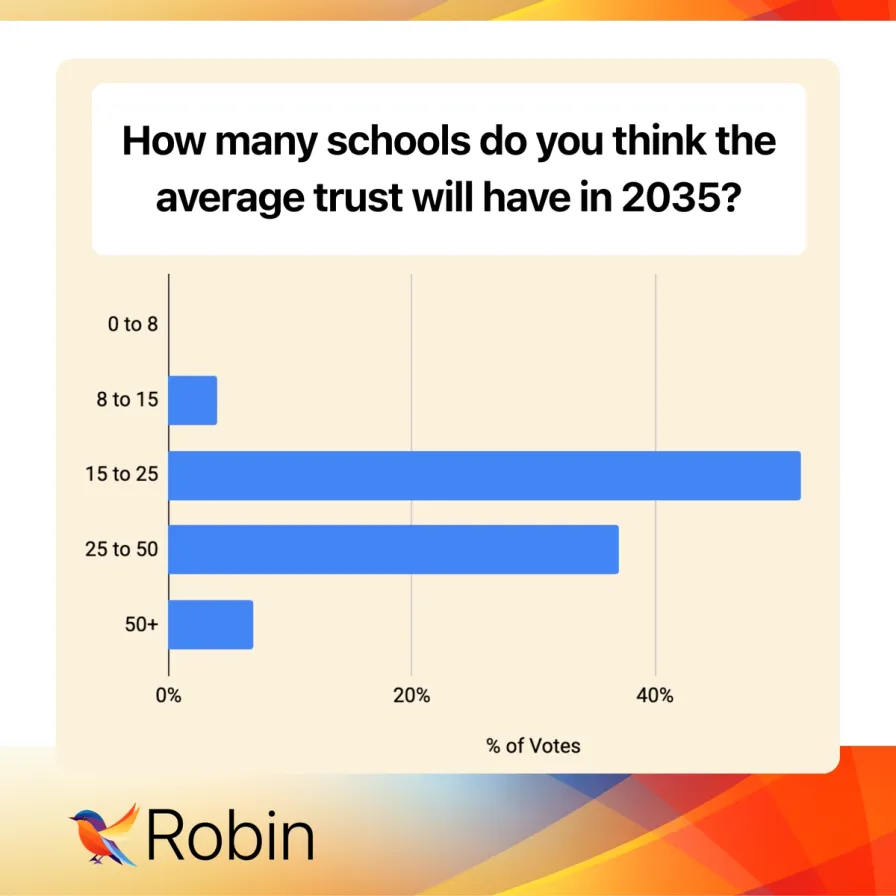
"We do need to consider that “number of schools” can be misleading – eight small primaries vs eight large secondaries make up very different trusts. Pupil numbers can be a better measure when thinking about scale and the “trust dividend.” Samira (CST)
---
Question 5: What have you learnt about leading people across a trust as it grows?
Matt (Embark):Visibility really matters. I try to get around our schools at least once a term. We’re coming up to the Christmas period and I have about 20 nativities booked in across the next few weeks. We do formal surveys, but I also do an “unofficial survey” by visiting schools, meeting staff, seeing the pupils and asking headteachers what we do well and how we can improve.
A simple example: last year headteachers said they felt overwhelmed with the number of internal emails landing at similar times. So now we send one weekly central newsletter, which can replace many separate messages – creating clearer, more consistent communication.
Delegation is also crucial as you grow. Along with the consistency of approach from your team. I have incredible people working with me at Embark, and I’m very happy to delegate, share and let them work their magic.
---
Question 6: What can you learn from merging – bringing people and systems together?
Luke (King’s Group): Firstly I learnt that it’s important to work collaboratively as a unit – whatever the size of school, or your geographical location. Nowadays with shared tenancies headteachers and SLT can work closely together, with shared curriculum and practice.
When you merge with a different trust – it is a big cultural shift.
Merging into a different trust with more autonomous schools, means bringing together different cultures, and taking the best of both. Too much interconnectedness can create issues, but working in silos is also hard. The goal is developing collaboration within the trust and removing barriers, whether technology or people (or closed doors).
Ultimately people want to work together and share expertise. I spend my time saying, “Let’s just share.” If I see a good idea, I get that person to share and ensure they get the credit for it. Sharing comes at little cost, you learn from other people and it brings huge benefits, so we actively encourage that at our trust.
---
Question 7: In business there’s an expression: “Culture eats strategy for breakfast.” Is that true at trusts?
Samira (CST):Culture is absolutely essential. In drafting our mergers guidance and speaking to many trusts, the consistent message was: success depends on cultural fit and the people.
Culture needs defining: it’s leadership styles, decision-making, hierarchy vs distributed leadership, whether people feel trusted, staff voice (surveys, exit interviews), recruitment and development approaches, plus reputation in the community.
We included cultural due diligence in our latest guidance (School trust mergers – CST November 2025) and we give suggestions such as: get equivalent teams across trusts meeting and talking before merger, and speak to front-line staff, like receptionists, who know the community and families really well.
Evidence from wider sector mergers also points to culture being decisive. Key integration practices that we can learn from the private sector include: protecting core talent (retention), identifying leaders who bridge cultures, consistent transparent communication (even “nothing’s changed” updates) and deliberate cultural integration through joint CPD, joint projects, trust-wide forums.
It’s also about building a trust identity with parents, following up on Matt’s point: why don’t we use school newsletters to include trust-wide messages, so families understand they’re part of a larger structure.
To end, it’s all about culture.